Steam Heat & Radiator Repair in Prospect Heights, Brooklyn
A well-functioning radiator should bring quiet, steady warmth to your room without banging, hissing uncontrollably, or dripping dirty boiler water onto parquet floors. For older residential buildings across Prospect Heights, expert radiator repair in Prospect Heights, Brooklyn cures water hammer, restores balanced steam distribution, and stops stubborn valve leaks.
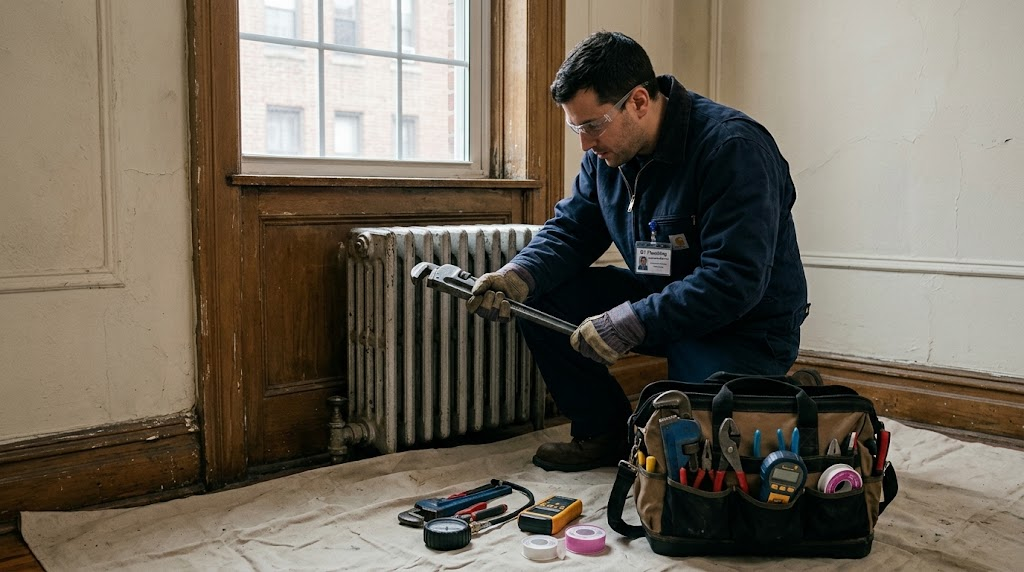
Common Radiator Symptoms & Diagnostic Solutions
Single-pipe and two-pipe steam radiators rely on gravity and atmospheric displacement. When components fail, distinct heating malfunctions occur:
Cold Radiator While Others Bake
Air trapped inside a radiator prevents steam vapor from entering. If the air vent has seized shut with mineral scale or internal float corrosion, cold air has no exit path. Replacing the vent with an appropriately sized orifice restores heat immediately.
Banging Pipes (Water Hammer)
In a single-pipe system, steam rises and condensate drains back down through the exact same pipe. If the radiator has settled backward away from the supply valve, water pools inside the casting. High-speed steam creates a vacuum collapse against pooled water, resulting in violent hammering.
Spitting Air Vents & Brown Water Leaks
Vents that squirt water or leave rusty stains on baseboards indicate boiler surging, foaming waterlines in the basement, or an unpitched radiator that has completely filled with condensate.
Single-Pipe Steam vs. Two-Pipe Vapor Systems
Understanding the piping geometry in your Brooklyn residence is crucial for selecting the correct repair parts:
Single-Pipe Steam Characteristics
- One Connection: Single pipe at the base serves as both steam inlet and condensate drain.
- Critical Pitch Rule: Radiator must pitch slightly downward toward the supply valve (approximately 1/4 inch per 10 feet of run).
- Angle Supply Valve: Must remain fully open or fully shut. Never modulate heat by throttling this valve.
- Thermostatic Radiator Valves (TRVs): Requires special one-pipe steam TRVs that vent air automatically based on ambient room temperature.
Two-Pipe Steam & Vapor Systems
- Dual Connections: Steam enters through a high supply valve; condensate and air exit through a return line at the opposite bottom corner.
- Steam Traps: Relies on thermostatic bellows traps on the return side to prevent live steam from blowing directly into the return lines.
- Failure Mode: Failed open steam traps overheat the basement return pipes, spike boiler fuel consumption, and create water hammer in neighboring apartments.
If systemic issues persist across the entire building, the root cause may lie in the basement heating plant. Read about our diagnostic sequence on the boiler repair homepage or explore complete plant overhauls on our boiler replacement page.
Step-by-Step Radiator Restoration Sequence
Restoring a historic cast-iron radiator requires delicate mechanical handling to avoid cracking century-old spuds or snapping floor risers:
Pitch Assessment
We check slope angles with precision levels, placing durable composite shims under radiator feet to guarantee unobstructed condensate drainage back to the riser.
Valve & Spud Inspection
We inspect brass union nuts, tailpieces, and packing stems. Worn packing is repacked or frozen angle valves are rebuilt with heavy-duty steam-rated components.
Air Vent Sizing & Balancing
Vents are calibrated to radiator size and distance from the boiler. Faster vents are installed on long runs while smaller orifices prevent short runs from overheating.
Thermal Testing
We fire the system to operating pressure, verifying smooth air venting without spitting, zero pipe knocking, and uniform heat distribution across all radiator sections.
Frequently Asked Questions About Radiator Repair
To learn more about local service across Brooklyn, view our neighborhood coverage details or contact our team to schedule an inspection.